Mounjaro vs. Placebo
(Adjunct to lifestyle intervention)
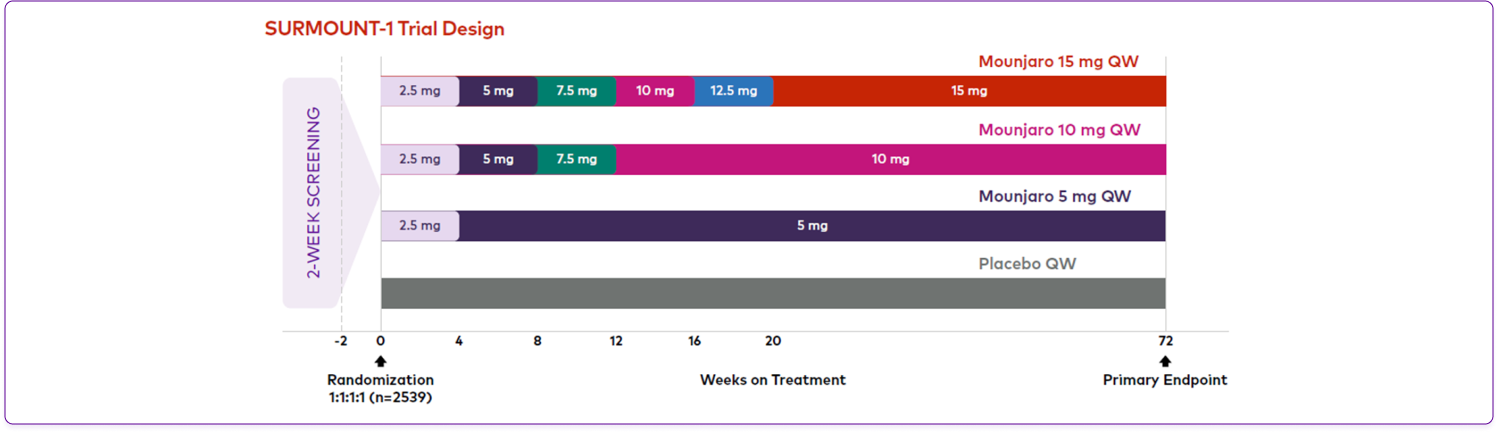
★ SURMOUNT-1 Trial Design
- 2539 patients were randomly assigned in a 1:1:1:1 ratio to receive Mounjaro at a dose of 5 mg, 10 mg, or 15mg or placebo, administered subcutaneously once weekly for 72 weeks as an adjunct to lifestyle intervention.
- Participants: Adults (18 years of age or older), with a body-mass index (BMI) of 30 or more, or a BMI of 27 or more and at least one weight-related complication (e.g. hypertension, dyslipidemia, obstructive sleep apnea, or cardiovascular disease), and who reported one or more unsuccessful dietary effort to lose weight.
CO-PRIMARY ENDPOINTS (10 mg and/or 15mg)
- Percentage change in weight from baseline at week 72
- Percentage of population with Weight Reductions of ≥5% at week 72.
KEY SECONDARY ENDPOINTS
- Change from baseline to week 72 in systolic blood pressure, fasting insulin, and lipid levels (triglycerides, HDL cholesterol, non-HDL cholesterol) (all doses combined).
- Percentage of population with Weight Reductions of ≥10%, ≥15%, and ≥20% at week 72 (10 mg and/or 15mg).
- Change from baseline to week 72 in waist circumference (10 mg and/or 15mg).
- Physical function score on the 36-Item Short Form Health Survey (SF-36), version 2, acute form (10 mg and 15mg).
★ Results seen at 4 weeks and continued through 72 weeks with Mounjaro
CO-PRIMARY ENDPOINTS (10 mg and/or 15mg)
- Percentage change in weight from baseline at week 72.
- Percentage of population with Weight Reductions of ≥5% at week 72.
Percentage change in body weight over time from baseline to week 72 (Efficacy estimand)
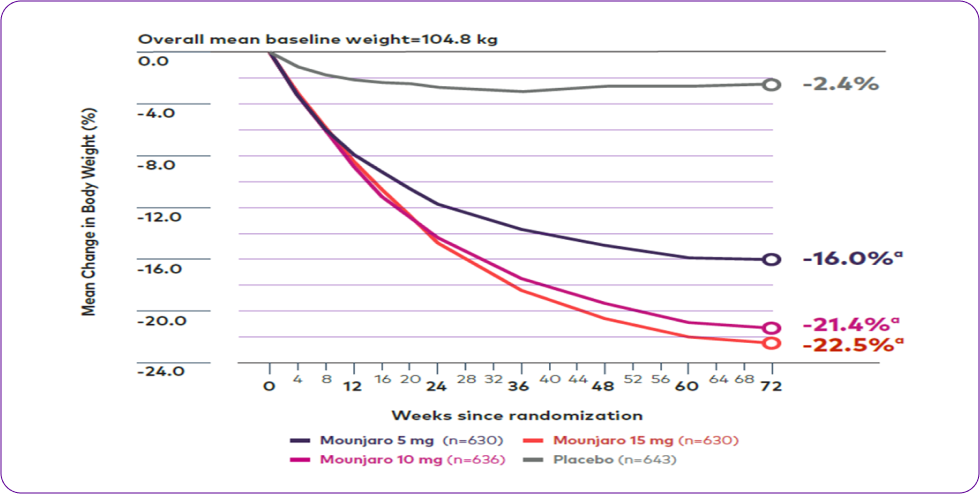
average reduction in body weight
With Mounjaro 15mg at 72 weeks
p<0.001 vs placebo, adjusted for multiplicity.
Efficacy estimand, MMRM analysis.
Studied in adults with obesity (BMI of ≥30 kg/m²) or with overweight (BMI of ≥27 kg/m²) with at least 1 weight-related complication, excluding type 2 diabetes.
All participants received lifestyle intervention, including a reduced-calorie diet and increased physical activity.
BMI=body mass index; mITT=modified intent-to-treat; MMRM=mixed model for repeated measures.
★ Significant Weight Reductions with the 3 doses of Mounjaro
CO-PRIMARY ENDPOINTS (10 mg and/or 15mg)
- Percentage change in weight from baseline at week 72.
- Percentage of population with Weight Reductions of ≥5% at week 72.
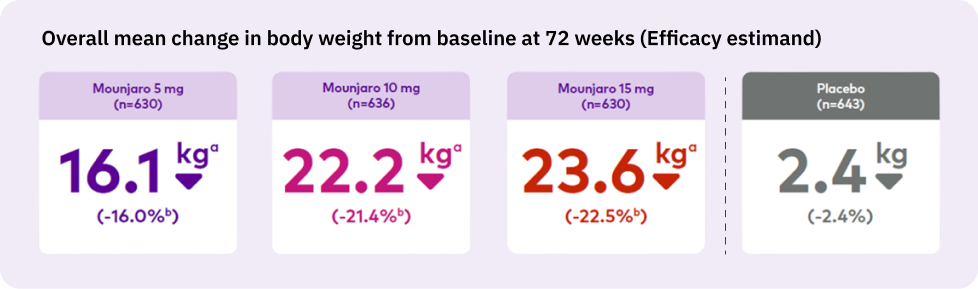
ap<0.001 vs placebo, not adjusted for multiplicity.
bp<0.001 vs placebo, adjusted for multiplicity.
Efficacy estimand, MMRM analysis.
Studied in adults with obesity (BMI of ≥30 kg/m2) or with overweight (BMI of ≥27 kg/m2) with at least 1 weight-related complication, excluding type 2 diabetes.
All participants received lifestyle intervention, including a reduced-calorie diet and increased physical activity. BMI=body mass index; mITT=modified intent-to-treat; MMRM=mixed model for repeated measures.
★ A majority of people taking Mounjaro achieved significant weight loss of ≥5%
CO-PRIMARY ENDPOINTS (10 mg and/or 15mg)
- Percentage change in weight from baseline at week 72.
- Percentage of population with Weight Reductions of ≥5% at week 72.
Percentage of people who achieved ≥5% Weight Reductions at 72 weeks (Efficacy estimated)
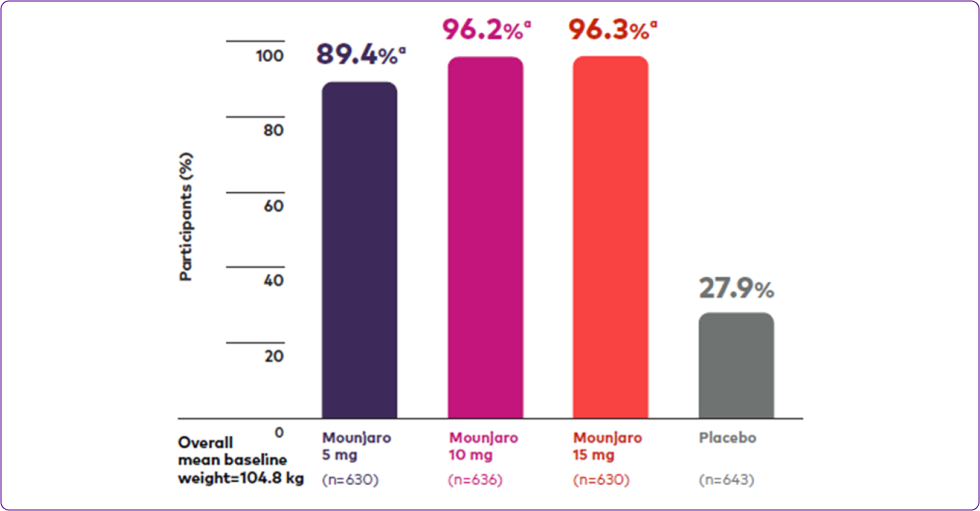
96%
of people taking Mounjaro
10 mg and 15mg
demonstrated clinically
significant weight loss of
≥5% at 72 weeks
ap<0.001 vs placebo, adjusted for multiplicity.
Efficacy estimand, logistic regression analysis.
Studied in adults with obesity (BMI of ≥30 kg/m²) or with overweight (BMI of ≥27 kg/m²) with at least 1 weight-related complication, excluding type 2 diabetes.
All participants received lifestyle intervention, including a reduced-calorie diet and increased physical activity.
BMI=body mass index.
★ Percentage of patients with ≥20% and ≥25% Weight Reductions
Percentage of people who achieved ≥20% and ≥25% Weight Reductions at 72 weeks
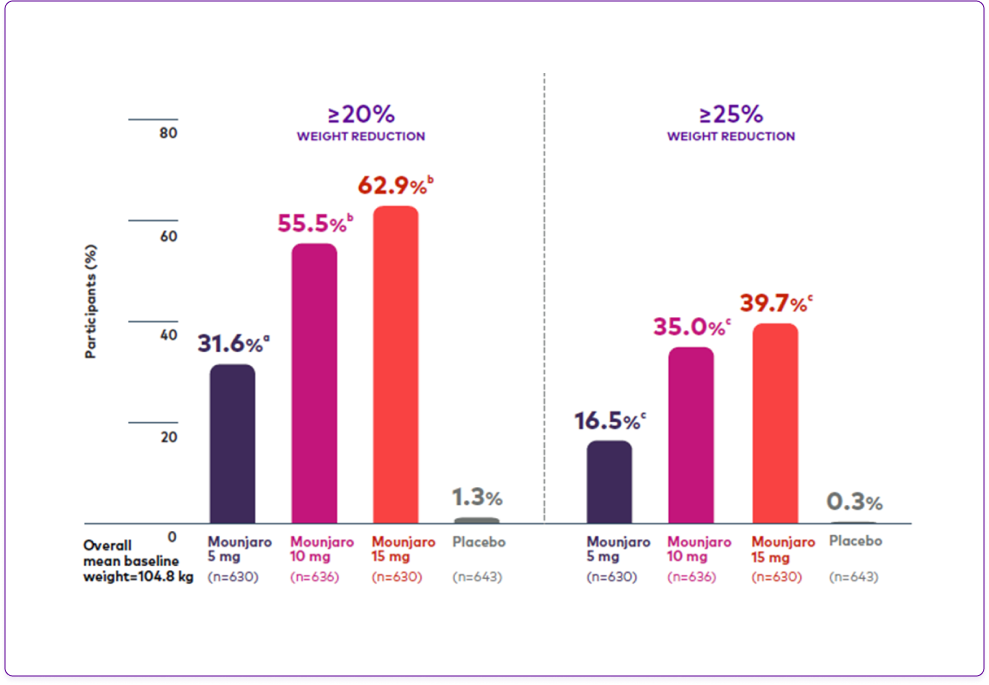
~4 in 10
people taking Mounjaro 15mg
demonstrated weight loss of
≥25%
at 72 weeks
ap<0.001 vs placebo, not adjusted for multiplicity.
bp<0.001 vs placebo, adjusted for multiplicity.
Efficacy estimand, MMRM analysis.
Studied in adults with obesity (BMI of ≥30 kg/m²) or with overweight (BMI of ≥27 kg/m²) with at least 1 weight-related complication, excluding type 2 diabetes.
All participants received lifestyle intervention, including a reduced-calorie diet and increased physical activity.
BMI=body mass index; mITT=modified intent-to-treat; MMRM=mixed model for repeated measures.
★ People taking Mounjaro experienced improvements in key cardiometabolic parameters
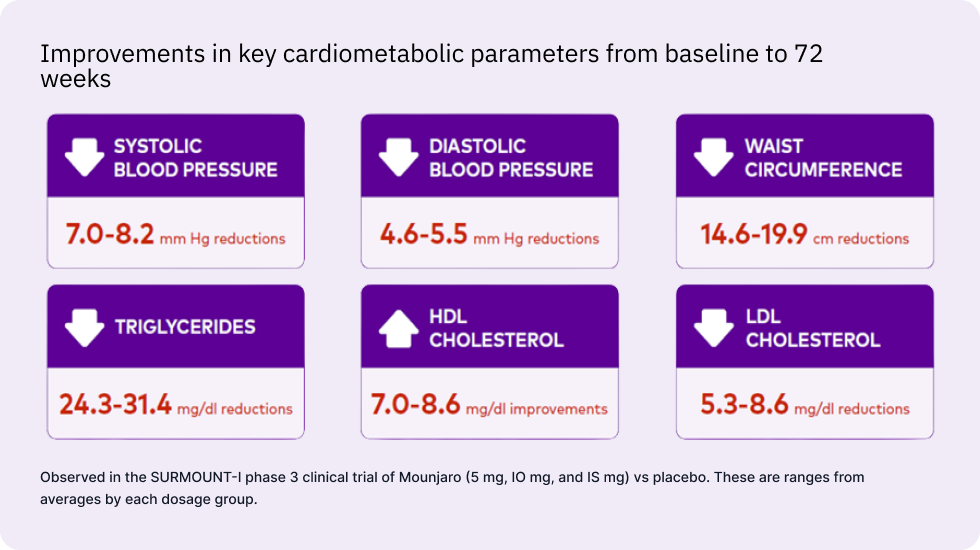
* Averages from each dosage group are the least-squares mean change from baseline.
Statistical tests were done for each dosage group, not the ranges from group means.
The efficacy estimand for individual doses was not adjusted for multiplicity, with the exception of waist circumference 10 mg and 15mg.
Studied in adults with obesity (BMI of ≥30 kg/m²) or with overweight (BMI of ≥27 kg/m²) with at least 1 weight-related complication, excluding type 2 diabetes.
All participants received lifestyle intervention, including a reduced-calorie diet and increased physical activity.
BMI=body mass index; HDL=high-density lipoprotein; LDL=low-density lipoprotein.
* Mounjaro is not indicated for the reductions of blood pressure or triglycerides
Jastreboff AM, Aronne LJ, Ahmad NN, et al. Tirzepatide once weekly for the treatment of obesity. New England Journal of Medicine. 2022;387(3):205-16.